Sunday, February 24, 2013

The Swiftian Satire


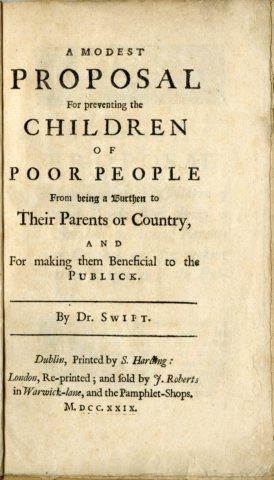
By Jonathan Swift [Public domain], via Wikimedia Commons
 The Swiftian Satire
          While reading “A Modest Proposal” by Jonathon Swift, the message that he was trying to bring about was quite clear, the living conditions of the poor needs to be changed.  He uses both Horace and Juvenal methods to bring this issue into the light, in hopes that someone would see how grotesque the situation is. 
          His suggestion of mother’s selling their babies to the rich for food, along with the suggestion that the babies skins could be used for fashionable wear is quite extreme and I feel that he used that suggestion in his satire to let the public know that the needs of the poor are just as extreme.  Yet, he does it in a humorous and illogical way so as not to offend society’s elite. 
          In the end, he does take a more serious tone to ask his readers for compassion and charity to those less fortunate.  At first, I thought that this was a very dark satire then as I read on I came to believe that is was actually an ingenious way to get attention towards what he sees as a growing problem.
To read the above satire click on the link below:

Sunday, February 17, 2013

Rhetorical Analysis


I picked the commerical for the Humane Society of America due to the emotional (Pathos) appeal directed at the audience they chose to reach.  Being an animal lover this commercial plays on the need to do something for animals that are being mistreated, abused, and neglected.  The down side to this commercial is the logic (Logos) of letting me believe that my $19 alone will help save countless of animals lives.  I think the argument for the fund raising would be more effective if they put a little more focus on the fact that if you donate you would be a part of a community or group effort to help save the animals and that together as a group, so much more could be done.

Sunday, February 10, 2013

Bartleby Essay

This week I have been working on my essay "Bartleby, Fact or Fiction."  I decided to go with Thesis Statement #2, which states that the character Bartleby is actually an imaginary character in the narrator's mind.  I was able to expand on this with many different points on how people use different ways to deal with inner turmoil and how people justify what they don't understand and what they don't want to face in their lives.  I even played with the idea that maybe it wasn't Bartleby that was lock up in the end but the narrator himself to help him deal with what Bartleby represents.  While this essay has been challenging, it has also been fun at the same time.

Sunday, February 3, 2013

Close Reading of Bartleby.


"Like a very ghost, agreeably to the laws of magical invocation, at the third summons, he appeared at the entrace of his hermitage."  This is the passage that stuck with me the most, mostly due to my past experience at working with people who have dementia, alzhiemers, and other mental defects that come from being elderly.  The narrator states that he is in fact elderly so that led me to think that Bartleby may have been in his imagination due to one of those illnesses which causes individuals to confuse past, present, and future.  He thinks of himself as a good person with compassion for others but as the story went he started questioning who he really is.  I found this story a little difficult to read at times just because of the language barrier yet, I still could see what the deeper meaning may be.

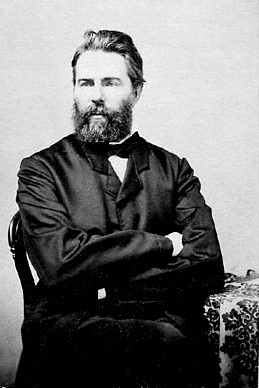
To learn more about the author Herman Manville, just click on the link.

In answering the question why we double space in essays, I was told once the reason is not only where the writer can make changes  but also it is easier on the eyes to read and the reader can also make their notes in the spaces so that they have a better understanding.